Many people are familiar with the Electrical Certificate of Compliance (COC) required when selling a home or applying for a bond. What is less well known is that complexes, townhouse developments, and sectional title properties often require a separate COC specifically for the common electrical installation. This is not the same certificate that covers an individual unit. The common electrical installation is a distinct installation, and under the Occupational Health and Safety Act (Act No. 85 of 1993) and the SANS 10142-1:2020 wiring code, it must be inspected and certified independently.
What Is the Common Electrical Installation?
In a complex or sectional title development, the common electrical installation refers to everything that falls outside the individual units and is shared by all residents. This includes the electrical kiosks and meter rooms, communal distribution boards, outdoor lighting, gate motors and their supply, communal plugs and sockets, and all the cabling that feeds these systems. Because this infrastructure serves multiple households, it must meet the same compliance standards as any residential installation and must be covered by its own COC.
Why Complexes Often Fall Behind on Common Property Compliance
Body corporates and managing agents are responsible for the upkeep of common property, but electrical compliance on communal infrastructure is frequently overlooked. Unlike a private home where the owner is directly accountable, responsibility for a complex can become blurred between the body corporate, trustees, and managing agents. Installations that were compliant years ago may have deteriorated, been modified informally, or simply never been brought up to current standards. By the time a formal inspection is carried out, there is often a backlog of non-compliant conditions that need to be remedied before a COC can be issued.
A Recent Project: Common Property Repairs at a Complex in Randpark Ridge
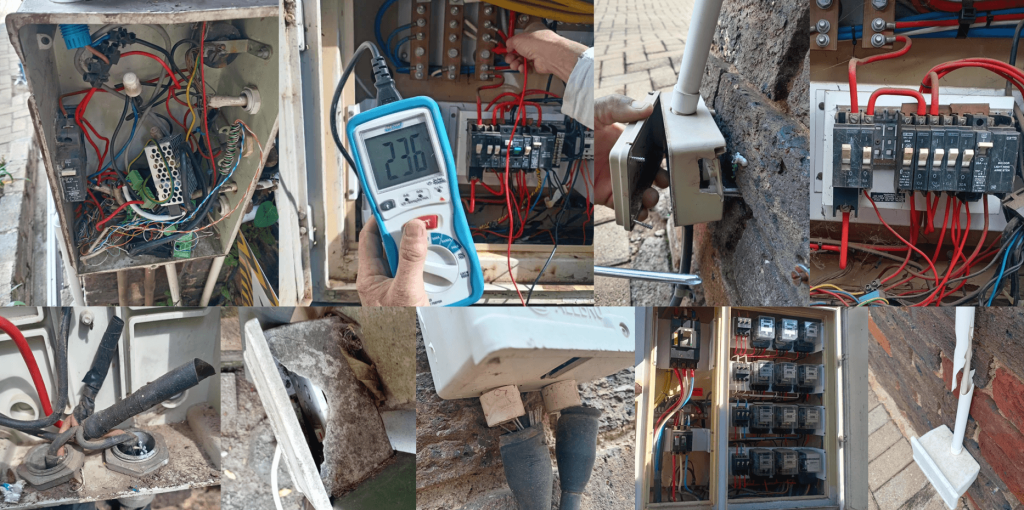
A complex in Randpark Ridge recently approached us to inspect and rectify the common electrical installation ahead of issuing a COC. The inspection revealed a range of non-compliant problems across the communal infrastructure, all of which needed to be addressed.
The kiosks where the electrical meters are housed had no earth leakage protection on the plug points used by the gardening staff. Three 63-amp isolators were required on the communal side of the kiosks as main switches. The gate board was in a non-compliant configuration, with the telecommunications and electrical supply sharing the same board. A new dedicated outdoor distribution board had to be installed to handle the 220V electrical supply to the gate motor and plug point.
Three outdoor plug boxes were found to be broken with exposed wiring and had to be replaced. Two open joints on exterior lights were repaired. A significant finding involved 98 armoured cable junction boxes on the outdoor lights adjacent to the garage walls. These were not connected to earth. Steel gland tags were fitted over the steel lock nuts of each gland and bridged to earth using lugs and 4mm earth wire, bringing all 98 connections into compliance.
The round park lights posed a further problem. They were being fed via a 2-core extension lead cabtyre cable, which meant the lights had no earth conductor and the cable itself was non-compliant. These lights were disconnected, and the client was advised to replace them with solar-powered lights as paving would have had to be dug up increasing costs.
All kiosks and distribution boards were labelled with the required danger stickers and fed-from identification stickers, and a reticulation diagram was produced for each kiosk to document the supply configuration.
What Happens After the Repairs?
Once all remedial work is complete and the installation meets the requirements of SANS 10142-1:2020, a formal COC is issued for the common electrical installation. This certificate is a legal document confirming the communal infrastructure is safe and compliant. It is separate from any individual unit COC and should be kept on record by the body corporate or managing agent.
Is Your Complex Up to Date?
If you manage or live in a complex in Roodepoort, Randburg, Krugersdorp, or the surrounding West Rand areas, it is worth confirming whether a valid COC exists for the common electrical installation. With over 37 years of experience and registration with both the Department of Labour and the Electrical Contractors Association (ECA), we carry out thorough inspections of communal electrical infrastructure, identify what needs to be done, and issue the COC once the installation is compliant. Contact us today to discuss your common property electrical compliance.
Read more about SANS 10142 and it’s role in electrical compliance.